

The Fullscript term loan has moved to direct lenders after the bank-underwritten deal failed to attract sufficient demand in the syndicated leveraged-loan market. The US$1.3 billion loan finances L Catterton and Altas Partners’ acquisition of healthcare platform Fullscript. Its reported clearing terms matter: a spread of four percentage points over the Secured Overnight Financing Rate (SOFR), issued at 96 cents on the dollar.
The leveraged-loan market declined the risk. Private credit accepted it, but only after the economics moved. That four-point original-issue discount (OID) is the signal. It means the private-credit market did not simply replace the public channel at the underwriters’ original economics. Instead, it demanded additional value upfront to absorb a loan that the broadly syndicated market would not clear.
How the Fullscript term loan moved from banks to direct lenders
Fullscript announced on 10 September that L Catterton and Altas Partners had agreed to acquire a majority stake from HGGC and Snapdragon Capital Partners. The company did not disclose the transaction’s valuation or equity contribution.
A Morgan Stanley-led bank group subsequently underwrote US$1.3 billion of acquisition debt with a maximum spread of SOFR plus 400 basis points. When leveraged-loan buyers did not provide enough demand, the exposure risked becoming a “hung” financing on the banks’ balance sheets.
That risk has now been transferred. Bloomberg-reported terms, carried by TradingView, show Antares Capital, Blue Owl Capital, Carlyle and Golub Capital among the direct lenders. The Fullscript term loan cleared at SOFR plus 400 basis points and a 96 original-issue price. Morgan Stanley separately provided a US$230 million revolving facility.
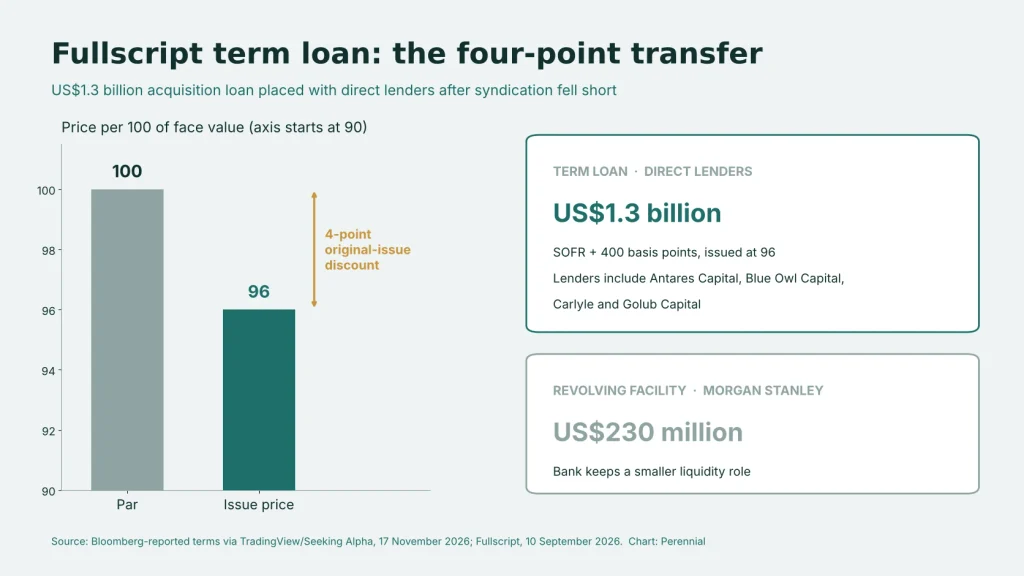
Chart: Perennial
What the Fullscript financing does not show
The confirmed facts establish a change in financing channel and price. They do not establish borrower distress, a payment default or deterioration in Fullscript’s operating performance.
The company remains privately held. Key credit terms have not been publicly disclosed, including leverage, maturity, amortisation, covenant protection, collateral coverage and sponsor equity.
Why private credit became the clearing venue
This is more than another large direct-lending deal. It shows private credit operating as the clearing venue for risk rejected by the syndicated market. Each party gains something different:
- Banks. The transaction limits balance-sheet exposure while preserving a relationship role through the revolver.
- Direct lenders. The four-point discount increases expected economics beyond the stated spread. However, the exact yield cannot be calculated without the loan’s maturity and amortisation schedule.
- Sponsors. Sponsors can still find capital, but the cost of certainty rises when public-market distribution fails.
The second-order issue is underwriting discipline. Private credit’s advantage is speed, certainty and negotiated documentation. Its risk is becoming the destination for loans that banks could not distribute, particularly if large managers feel pressure to deploy committed capital. Access to the asset is not the same as a sound structure.
Key questions inside the Fullscript loan documents
For the Fullscript term loan, the relevant questions now sit inside the documents:
- how much equity sits beneath the debt;
- whether maintenance covenants exist;
- how add-backs and incremental debt capacity are defined;
- whether the revolver and term lenders share collateral and recoveries on equal terms; and
- how much flexibility the sponsor retains to move assets, incur priority debt or extend maturities.
Capital and risk implications of the four-point discount
The immediate capital movement is clear. Term exposure moves from bank underwriters to non-bank balance sheets, while the bank retains a smaller, more transactional liquidity facility.
If this pattern repeats, banks may underwrite acquisitions with greater confidence that private-credit platforms can provide a backstop. In turn, direct lenders will increasingly price that service through discounts, fees and tighter control rights.
That could widen the gap between headline spreads and true borrower cost. A loan quoted at SOFR plus 400 basis points may look unchanged, yet a 96 issue price materially increases the lender’s return and the sponsor’s financing burden. It also creates mark-to-market sensitivity: investors entering at par through a fund vehicle should understand that the underlying loan began life below par.
The risk is not that one US$1.3 billion loan destabilises the market. Rather, it is that repeated transfers turn private credit into a warehouse for execution risk originating in bank underwriting books. Concentration, valuation and documentation then matter more than the asset-class label.
Frequently asked questions
What happened to the Fullscript term loan?
A Morgan Stanley-led bank group underwrote US$1.3 billion of acquisition debt for L Catterton and Altas Partners’ purchase of Fullscript. When syndicated leveraged-loan demand fell short, direct lenders took the Fullscript term loan, including Antares Capital, Blue Owl Capital, Carlyle and Golub Capital. It reportedly cleared at SOFR plus 400 basis points and a 96 issue price.
What does a 96 issue price mean for the Fullscript term loan?
The Fullscript term loan was issued at 96 cents on the dollar, a four-point original-issue discount. Lenders demanded that additional value upfront, which increases their expected economics beyond the stated spread. The exact yield cannot be calculated without the loan’s maturity and amortisation schedule.
Is Fullscript in financial distress?
The confirmed facts do not establish borrower distress, a payment default or deterioration in Fullscript’s operating performance. They show a change in financing channel and price. The company remains privately held, and key credit terms have not been publicly disclosed.
Why does the deal matter for private credit investors?
The Fullscript term loan shows private credit acting as the clearing venue for risk the syndicated market rejected. The risk is that private credit becomes the destination for loans banks could not distribute. Investors entering at par through a fund vehicle should also understand that the underlying loan began life below par.
What would weaken Perennial’s view?
The thesis would weaken if broadly syndicated demand reopens, discounts normalise and banks again distribute comparable sponsor loans without relying on direct-lending takeouts.
The Perennial view
The Fullscript financing is a price-discovery event, not a credit accident.
Private credit has shown it can clear a transaction the syndicated market would not. But it cleared only after demanding a four-point discount, and that distinction is the story. The market remains open; it is no longer indiscriminate.
Perennial Market Intelligence is watching three triggers:
- whether more bank-underwritten acquisition loans migrate to direct lenders;
- whether original-issue discounts deepen beyond the mid-90s; and
- whether private lenders secure stronger covenant and collateral protections in exchange for providing execution certainty.
The thesis would weaken if broadly syndicated demand reopens, discounts normalise and banks again distribute comparable sponsor loans without relying on direct-lending takeouts. Until then, the economics, not the availability of capital, are setting the boundary.
We can see where the shift is developing. The next question is whether private lenders are being paid for genuine control, or merely for absorbing distribution risk. Sign up free to follow our deeper analysis. [Free signup — link pending]
Explore more analysis on private credit and direct lending at Perennial Markets.
Where Insight Meets Opportunity.
Sources
- Fullscript Announces Investment from Altas Partners and L Catterton — Fullscript, 10 September 2026
- Morgan Stanley-led group gets $1.3B loan from private credit for Fullscript deal — TradingView/Seeking Alpha, citing Bloomberg, 17 November 2026
This material is for general financial information only and does not constitute investment, legal, tax or personalised financial advice. Private-market investments involve material risks, illiquidity and eligibility restrictions.


