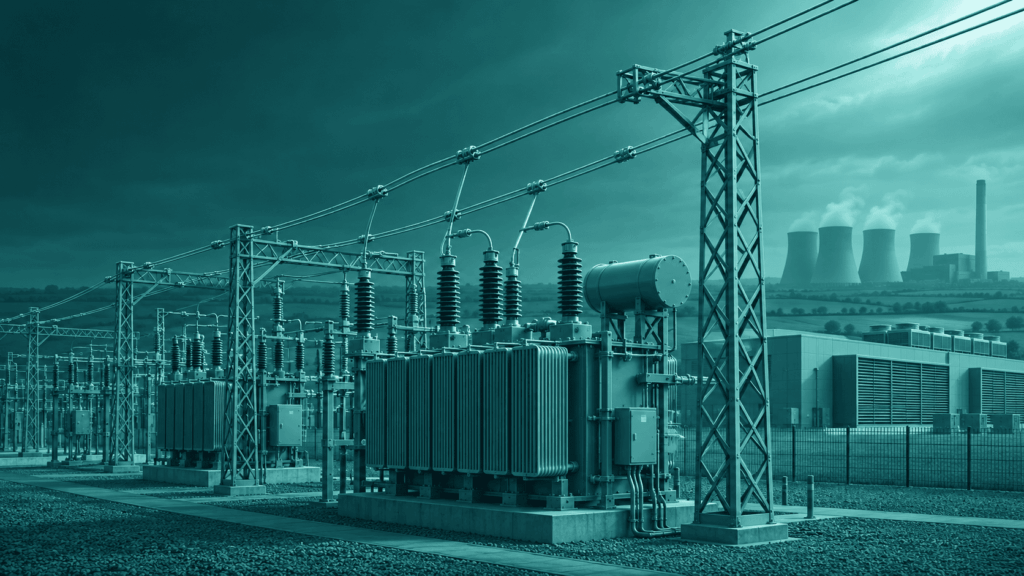
The proposed Drax AI data centre puts a value on something developers can spend years securing: access to power at scale. Drax has signed an agreement with Brookfield and Radiant to develop more than 1 gigawatt (GW) of data centre capacity at Drax Power Station in North Yorkshire. Brookfield estimates that total investment could exceed £20 billion, including semiconductor chips. The first phase targets up to 100 megawatts (MW) from the first quarter of 2028 and could attract £2.5 billion in investment.
How the Drax AI data centre would secure power
The power station estate already has around 4 GW of grid access, 2.6 GW of dispatchable generation and existing cooling infrastructure. Drax brings the site and its power capabilities, while Radiant, Brookfield’s UK AI infrastructure platform, brings development and operating expertise. The project would draw on backing from the Brookfield–Qai AI infrastructure joint venture.
The first phase would import electricity directly from the grid. From 2028 to 2031, the partners aim to add up to 500 MW through a behind-the-meter arrangement. Under that proposal, the power station would supply electricity directly to the data centre under a long-term power purchase agreement, subject to the necessary consents. Further capacity could follow after 2031. The site’s existing connection gives the project a head start, while each phase still depends on the power it can secure on commercially viable terms.
What the £20 billion investment estimate covers
Brookfield’s estimate covers the full development, including chips, and spans multiple phases. The first phase still needs planning, regulatory and network approvals, a suitable anchor tenant, negotiated commercial agreements and final investment decisions from the partners. The announcement also leaves debt funding, leverage, lender security and the allocation of construction and operating risk open.
Each of those conditions affects the project’s ability to raise debt. An anchor tenant can support borrowing if its payment obligations are enforceable and its rights to walk away after a delay are limited. A power contract can protect operating margins if it establishes how much electricity will be delivered, when delivery starts and how prices are set. Together, those contracts determine how much cash flow lenders can underwrite before construction begins.
Why grid access changes data centre financing
Power stations and industrial estates with existing grid connections may become more valuable to data centre developers because they can bring forward the date when a site can serve customers. The premium depends on how much power the project can use, when it can use it and what network or operating obligations come with that access. At Drax, the existing infrastructure also creates several potential sources of collateral, from land and buildings to electrical equipment and cooling systems.
Those assets have different useful lives. Buildings and power infrastructure can operate for decades, while graphics processing units (GPUs) can lose value over a much shorter period. A financing structure can reflect those differences through long-term capital for the site and power infrastructure, construction debt released against milestones and equipment loans with faster repayment schedules. Once the campus is operating, lenders can size debt against contracted customer payments and the cash available after power and operating costs.
US securitisation markets offer context for how investors were pricing data centre exposure in late October. In its 3 November market commentary, the Commercial Real Estate Finance Council reported that Bank of America marked fixed-rate, single-asset, single-borrower data centre mortgage securities at 195 basis points over US Treasuries for AAA debt and 435 basis points for BBB debt as of 29 October. Its single-A data centre asset-backed securities benchmark reached 200 basis points over Treasuries. These are US market benchmarks. Drax’s borrowing costs will depend on its own contracts, collateral and financing structure.
How UK energy policy affects the Drax project
The UK’s Data Centre Covenant offers qualifying strategic projects a route to faster planning and grid connections. It also sets expectations for contributions to energy-system costs, local benefits, water use and reporting. New facilities should be designed for a power usage effectiveness ratio of 1.3 or lower. For lenders, these requirements can affect construction costs, operating assumptions and the timetable for delivering power to a tenant.
Drax’s biomass Contract for Difference adds a specific condition to the second phase. The contract covers April 2027 to March 2031 and gives Drax a mechanism to request permission to use up to 500 MW to power a data centre during that period. The UK Government and the Low Carbon Contracts Company would need to agree, taking account of value for consumers, energy security and sustainability. That approval will shape how much capacity the partners can support with on-site generation during the proposed expansion.
The Perennial view
Drax’s existing grid connection gives the project a practical advantage in a market where the timing of power delivery can determine when a data centre starts earning revenue. The next evidence will come from the anchor tenant agreement, phase-one approvals and the terms of the construction and equipment financing. We will look for enforceable minimum payments from the tenant, clear commitments on power delivery and a funding structure that assigns early development losses and repays equipment debt before the hardware loses much of its value.
Explore more analysis on private credit and private markets at Perennial Markets.
Where Insight Meets Opportunity.
Sources
Disclaimer: This publication provides general financial information and market intelligence only. It is not personal financial advice, an offer, solicitation or recommendation. Private-market and infrastructure investments involve construction, technology, leverage, liquidity, valuation and loss risks. Eligibility and access may be restricted.