
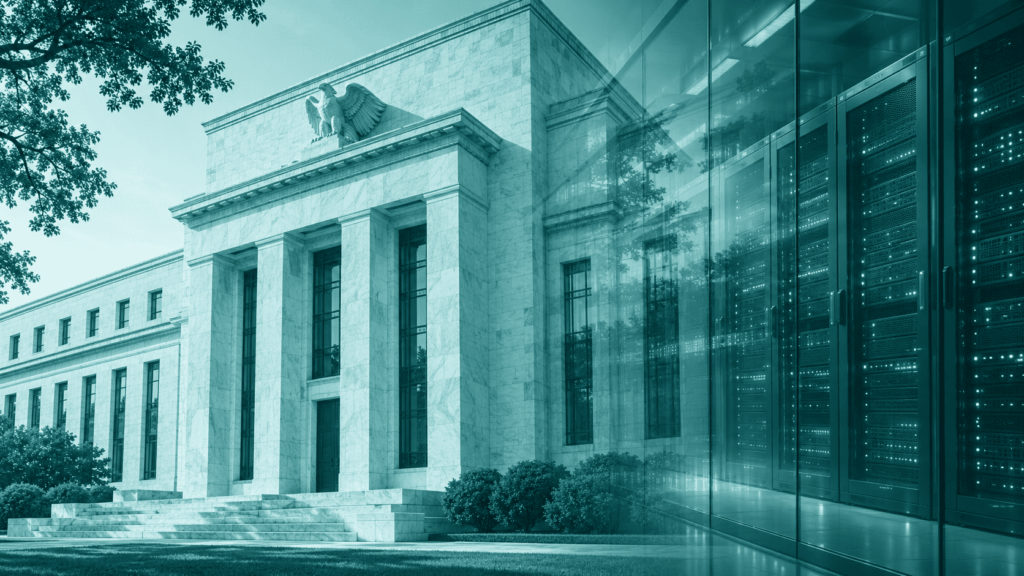
AI infrastructure credit is now a financial-stability issue discussed inside the Federal Reserve. Minutes from the Federal Open Market Committee’s (FOMC) 27–28 October meeting, released on 18 November, show that almost all participants discussed the risk that returns on AI investment disappoint. Most noted that AI-related debt has grown rapidly, and that much of the growth has occurred through financing structures that are complex and opaque.
The topic is no longer only a sector story for chip analysts, data-centre lenders and private-market investors. Several participants warned that bank supervisors may not fully capture indirect exposure through non-bank financial institutions, including credit lines extended to private-credit funds. That is the material change. The Fed is not predicting a crisis. It is confirming that the financing architecture has become large, interconnected and difficult to observe as policy is likely to tighten further.
What the FOMC minutes say about AI infrastructure credit
The minutes connect three previously separate signals:
- Risk sentiment. The Fed’s market desk said financing plans requiring more debt than investors expected had weakened risk sentiment. Credit spreads widened in investment-grade and high-yield markets. High-yield bonds funding data-centre construction showed especially notable widening.
- Structure. AI debt is increasingly concentrated among a limited number of firms. It is distributed through special-purpose vehicles, private placements, private-credit funds, insurers and bank facilities. Several participants questioned whether supervisory data adequately capture banks’ indirect exposures to those channels.
- Policy backdrop. Almost all participants judged that further increases in the federal-funds target would probably be appropriate. Two said a move larger than 25 basis points could warrant consideration if inflation deteriorates.
Higher rates raise debt-service costs and reduce refinancing capacity. They also make long-dated project economics more sensitive to delays and utilisation assumptions.
How off-balance-sheet AI data-centre financing works
The Bank for International Settlements (BIS) has described the core structure behind much of this AI infrastructure credit. A hyperscaler or technology sponsor can place a data centre in a dedicated vehicle, contribute a minority equity stake, sign a long-term lease or capacity agreement, and provide selected guarantees. The vehicle raises debt from private-credit funds and institutional investors, while banks provide revolvers or warehouse facilities.
Economically, the structure converts upfront capital expenditure into a contractual payment stream. Much of the debt, however, sits away from the sponsor’s main balance sheet. The BIS calls this “shadow borrowing”: obligations that resemble debt in substance but reside in structures whose risks are distributed among lenders, insurers, sponsors and banks.
This can be sound finance when contracts are enforceable, sponsors are creditworthy, power is secured, completion risk is controlled and leverage is conservative. It becomes fragile when modelled utilisation substitutes for contracted cash flow, guarantees are narrow, construction slips, collateral depreciates quickly or refinancing is assumed rather than committed.
The transmission path matters. A project does not need to default for conditions to tighten. Wider spreads can reduce loan values, force additional equity, delay refinancing or prompt lower advance rates. A private-credit fund may then draw a bank facility, sell a loan or restrict investor liquidity. As a result, banks can have limited direct project exposure but meaningful contingent exposure through fund lines, commitments and guarantees.
Why the ING loan sale is a pricing test
The market is already testing the structures behind AI infrastructure credit. ING put approximately US$500 million of data-centre loans up for sale in November, including exposures linked to Stargate, Vantage Data Centers and CyrusOne. Bids were due on 19 November in minimum sizes of US$10 million.
A portfolio sale does not prove credit deterioration. Instead, it creates a clearing-price test for loans usually held away from transparent markets.
The result is a two-speed funding market. Large platforms can still attract equity, while leveraged infrastructure vehicles face wider spreads, smaller deals and deeper scrutiny of guarantees. Equity investors buy upside; lenders require contractual repayment.
Where capital may move in AI infrastructure credit
In AI infrastructure credit, capital is likely to favour structures with visible cash flows and genuine loss protection: contracted capacity, strong sponsor equity, enforceable completion support, conservative loan-to-cost ratios, cash sweeps and limits on additional debt. Investors may also demand shorter duration or amortisation that reduces reliance on one refinancing event.
Banks may reduce concentrated term exposure while retaining fee-generating revolvers, hedging relationships and distribution roles. Private-credit managers and insurers can absorb assets, but only if spreads compensate for construction, technology, power, counterparty and liquidity risk.
The asset-class label is insufficient for AI infrastructure credit. Two loans in the same sector can be economically different:
| Secured loan on a completed facility | Construction loan | |
|---|---|---|
| Asset | A completed, powered facility | A facility still being built |
| Repayment depends on | A durable investment-grade offtaker | Future leasing, refinancing and equipment residual values |
Four risks for lenders and investors
Perennial sees four risks in AI infrastructure credit:
- Opacity. Private marks can adjust more slowly than public credit spreads.
- Liquidity mismatch. Semi-liquid vehicles may offer periodic redemptions while holding loans that can only be sold quickly at a discount. If withdrawals rise as marks fall, a fund may borrow, sell better assets or prorate requests.
- Concentration. The same technology companies can appear as tenants, guarantors, equity sponsors, equipment suppliers and customers. Apparent diversification can conceal a shared counterparty or demand assumption.
- Policy feedback. AI construction supports growth but raises demand for power, equipment and skilled labour. If that contributes to inflation, the monetary response increases the cost of financing the same build-out. A project can be economically productive and still be poorly financed.
Frequently asked questions
What did the FOMC minutes say about AI infrastructure credit?
The minutes show AI infrastructure credit is now a financial-stability issue discussed inside the Fed. Almost all participants at the FOMC’s 27–28 October meeting discussed the risk that returns on AI investment disappoint. Most noted that AI-related debt has grown rapidly through complex and opaque financing structures. Several warned that bank supervisors may not fully capture indirect exposure through non-bank lenders, including credit lines to private-credit funds.
What is shadow borrowing in AI data-centre finance?
Shadow borrowing is the BIS term for obligations that resemble debt in substance but reside in structures whose risks are distributed among lenders, insurers, sponsors and banks. In AI data-centre finance, much of this debt sits in dedicated vehicles away from the sponsor’s main balance sheet.
How can banks be exposed to AI infrastructure credit without lending to projects directly?
Banks can have limited direct project exposure but meaningful contingent exposure through fund lines, commitments and guarantees. If wider spreads reduce loan values, a private-credit fund may draw a bank facility, sell a loan or restrict investor liquidity.
Why does the ING data-centre loan sale matter?
ING put approximately US$500 million of data-centre loans up for sale in November, with bids due on 19 November. A portfolio sale does not prove credit deterioration, but it creates a clearing-price test for loans usually held away from transparent markets.
Is the Fed predicting a crisis in AI debt?
No. The Fed is not predicting a crisis. It is confirming that the financing architecture has become large, interconnected and difficult to observe as policy is likely to tighten further.
The Perennial view
The Federal Reserve has not called the end of the AI build-out. It has identified the point at which financing structure becomes a macro risk.
The investable signal is not “AI debt is dangerous.” It is that underwriting must move from theme to contract: who must pay, what happens if construction is late, how much equity absorbs losses, whether guarantees survive stress, how the asset is valued and where refinancing risk sits.
The thesis would weaken if data-centre credit spreads compress, portfolio sales clear near carrying values, bank exposures remain contained and projects demonstrate contracted utilisation with stable cash generation. It would strengthen if loan sales require discounts, facilities are repeatedly downsized, private funds draw liquidity lines or guarantees are activated.
Perennial Market Intelligence is watching the ING auction, new high-yield and private data-centre pricing, and bank commitments to non-bank lenders. It is also tracking covenant packages, loan-to-cost ratios and the gap between public spreads and private marks.
We can see where the shift is developing. The next question is which structures are paid adequately for risk, and which merely disguise it. Sign up free to follow our deeper analysis. [Free signup — link pending]
Explore more analysis on AI infrastructure financing at Perennial Markets.
Where Insight Meets Opportunity.
Sources
- Minutes of the Federal Open Market Committee — Federal Reserve, released 18 November 2026
- Financing the AI infrastructure boom — Bank for International Settlements, March 2026
- ING puts $500 million of data-center loans up for sale — Reuters, 6 November 2026
Financial-information disclaimer: This material is general information only and does not constitute investment, legal, tax or personalised financial advice. Private-market and infrastructure investments involve material risks, illiquidity, valuation uncertainty and eligibility restrictions.


